|
PodMng Software |
|
Each instrument is supplied with an installation CD containing the PodMng software, electronic format user manual and a choice of drivers for third party applications packages. The PodMng software can be used as a setup tool, basic data analysis package and diagnostic tool. The features of the PodMng software are shown below. |
|
SigDAQ Signal Analysis software |
|
SigDaq is the Keynes Controls general purpose data analysis software. The package can be configured to create many different types of condition monitoring solutions such as vibration analysis, bearing failure detection, run-up and down tests, balancing systems ect. |
|
|
|
Waterfall diagrams for run-up and down operations. |
|
Vibration Power Spectra - to 512 lines with enhancement options. |
|
|
|
Mathematical Libraries |
|
The SigDAQ software contains a number of specialised mathematical library functions containing many of the procedures required for condition monitoring. Many different analysis plots can be configured and left to run in the background, only being selected as and when needed. |
|
|
|
Since the SigDAQ software is general purpose in nature, it can be configured to suit nearly any condition monitoring application from machine run-up tests to shaft whirling. |
|
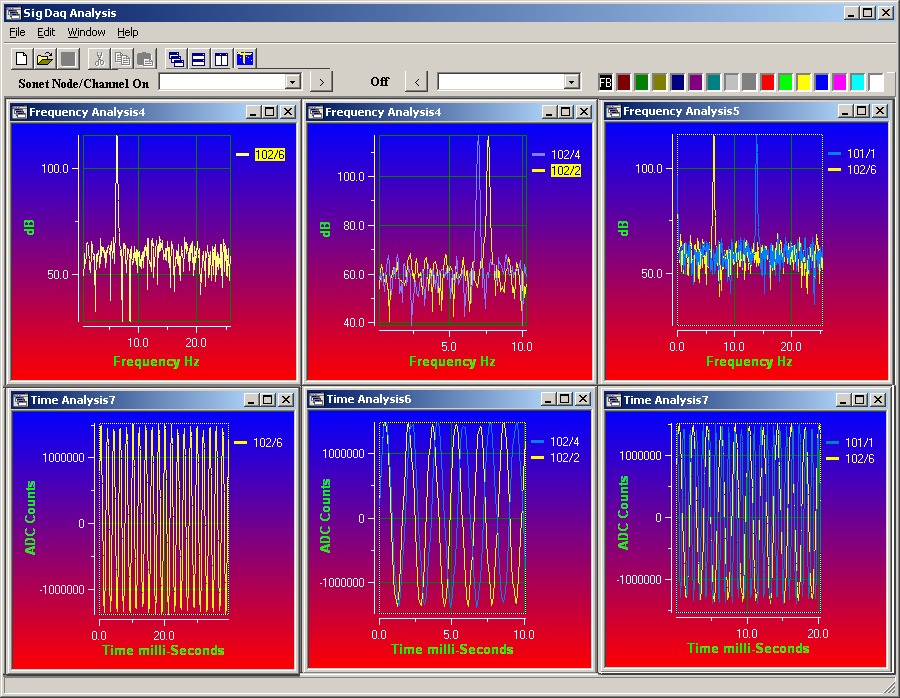
Fig 21 - Vibration Analysis Plots |
|
Fig 21 above demonstrate a multi vibration plot screen from a number of sensors distributed across a network. |
|
Each user receiving data from the NetPods will observe an identical configuration window similar to the one shown above. Any changes to the number of instruments, channel configurations and calibration details are automatically updated and presented |
|
within this window. |
|
The NetPod.dll (Dynamic Link Library) enables custom program development under the Microsoft 200/NT/XP operating systems to be undertaken. The NetPod.dll supports multi-tasking, multi-instrument operations across a network. Multiple applications can share the same driver. An application program can perform all of the analogue processing, digital control and system management operations supported by the different interfaces. |
|
|
