|
Condition monitoring often involves the interpretation of waveforms from measurements by transducers. Most waveforms from rotating machinery will be periodic or precisely approximately periodic in nature. Condition monitoring of machinery normally use a measuring device that produces a signal that can be processed to represent a physical variable. Many of these signals are periodic or approximately periodic, so a considerable amount of information can be gleamed from Fourier Analysis.
The accuracy of the measurements and the timing of adjacent samples within the Keynes Controls instruments ensures that spectral analysis and time based analysis of the input data streams can be accurately carried out. Data can be digitised from any of the analogue input modules and compared against the features within adjacent channels no matter what interface is being used.
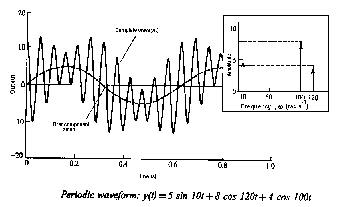
Key components of many of the condition monitoring techniques is the calculation of time based statistics over a period of time. Figure 7 shows the information that can be obtained from a periodic time history. Statistics such as mean, rms, Kurtosis, standard deviation can be calculated within the analysis software.
The content of a multi-frequency periodic signal can be be determined using Fourier Spectrum analysis. A suitable Fourier spectra is used to obtain statistical information about the signal component under investigation and also to monitor the amplitude and frequency of the main system components. Trend plotting of the spectral peeks and information regarding amplitude can and is used as a very powerful tool to monitor the operations of a rotating machine.
Spectral analysis allows a complex signal to be broken down into its individual components. Figure 8 demonstrates clearly a multi frequency signal is analysed. A suitable Fourier spectra can be used to integrate a acceleration time history into velocity and displacement results.
|