
|
Nature of Fault |
|
Frequency of Dominant |
|
Direction |
|
Remarks |
|
Rotating members |
|
1 x rpm |
|
Radial |
|
A common cause of excess vibration in machinery |
|
Misalignment & |
|
Usually 1 x rpm |
|
Radial |
|
A common fault |
|
|
|
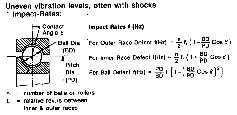
Impact rates for |
|
Radial |
|
Journal Bearings |
|
Sub-harmonic of shaft rpm. Exactly ½ or 1/3 x rpm |
|
Primarily |
|
Looseness may only develop at operating speed and temperature |
|
Oil Film Whirl or Whip |
|
Slightly less than |
|
Primarily |
|
Applicable to high-speed (e.g. Turbo ) machines |
|
Hysteresis Whirl |
|
Shaft critical speed |
|
Primarily |
|
Vibrations excited when passing through critical shaft speed are maintained at higher shaft speeds. Can sometimes be cured checking tightness of rotor components. |
|
Damaged or |
|
Tooth meshing frequencies (shaft rpm x number of teeth) & harmonics |
|
Radial |
|
Sidebands around tooth meshing frequencies indicate modulation (e.g. Eccentricity) at frequency corresponding to sideband spacings. Normally only detectable with very narrow band spectral analysis |
|
Mechanical |
|
2 x rpm |
|
Also sub- and inter-harmonics, as for loose Journal bearings. |
|
Faulty Belt Drive |
|
1, 2, 3 & 4 x rpm of belt |
|
Radial |
|
The precise problem can usually be identified visually with the help of a stroboscope |
|
Unbalanced Recipricating |
|
1 x rpm and/or |
|
Primarily |
|
Increased Turbulence |
|
Blade and Vane passing frequencies and harmonics |
|
Radial |
|
Increasing levels indicate increasing turbulence |
|
Electrically Induced Vibrations |
|
1 x rpm or 1 or 2 times |
|
Radial |
|
Should disappear when turning off the power |
|
Vibration Troubleshooting Chart |
|
6 |
|
Copyright Keynes Controls ã 2004-2005 |