Vibration Monitoring

The majority of condition monitoring problems ultilise vibration analysis techniques in one form or another. The following section details the vibration analysis techniques and instrumentation used to solve these problems.

Vibration monitoring makes use of vibrations generated by virtually all dynamic systems e.g. Rotating machinery. Individual components often generate distinctive vibration patterns which can indicate their condition or any change in their condition.

The ability to record and identify vibration ‘signatures‘ makes the technique so powerful for monitoring rotating machinery. And coupled with the relative ease and low cost implementation, it explains why vibration monitoring is applied so extensively to rotating machinery, compared with other techniques
.

Techniques

Vibration analysis is normally applied by using transducers to measure acceleration, velocity or displacement. The choice of analysis depends on the frequencies to be analysed:

·

Acceleration covers frequencies 0 - 20 KHz and beyond


·

Velocity covers frequencies typically 2 - 2 KHz


·

Displacement, a measure of absolute position covers frequencies 0.001 up to 200 Hz.

Sensor Interfaces

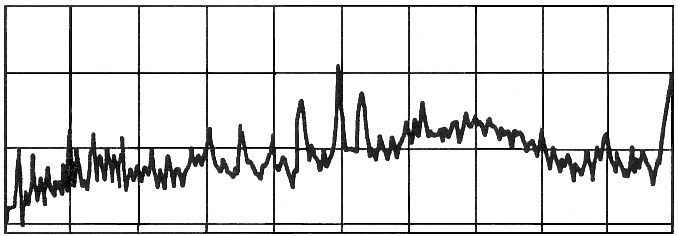
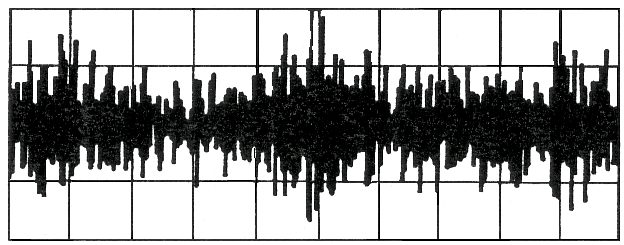
The NetPod 4000 instrument can be configured to accept sensor inputs from most types of vibration detectors. The most common sensor used for this type of analysis being the ICP accelerometer which requires constant current drive. It offers good noise immunity and is simple to install and operate. Figures 3 and 4 below show a time history trace and corresponding spectral analysis from this sensor.

The NetPod 4000 uses a standard interface and integral power supply to drive an ICP accelerometer. See Part numbers NPAI24-V1H1, NP4501-ACL (ICP Accel)


Time (s)

Frequency (Hz)

0

50

20

30

40

0

8

-62

-2

Fig 3

Fig 4

Vibration sensors are supplied in different sizes and shapes and supply an output signal that can be in the form of a variable voltage or current. No matter what type of output is generated the 4000 system interfaces can read these signals and convert them into suitable engineering units:

Part Numbers: NPAI24-V1H1 24 bit Voltage Interface

NPAI16-V178K 78 KHz 16 bit interface

Contact Keynes Controls for specialist vibration interfaces

Which vibration readings to take

Vibration information is used to identify machine faults which are present or those which are developing, faults which can be diagnosed with reasonable confidence. There is an implicit need for a link between a mode of failure and a detectable vibration characteristic (e.g. Running speed frequency generated by imbalance). And there is a trade off between the number of measurement types at a given measurement point and the cost of collecting and assessing the data.

When choosing measurement points, remember that different components will have different failure modes and will require different monitoring techniques. Different monitoring techniques measure different variables and this may affect the placement of measurement points.

With different types of measurement techniques required to create a condition monitoring system the Keynes Controls NetPod 4000 instruments can be individually configured to suit many tasks. Any mixture of sensor inputs can be installed enabling vibration monitoring to be carried out at the same time as load and temperature measurements.

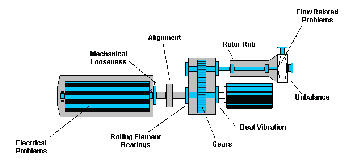
Fig 8 illustrates a typical measurement points on a pump; vibration analysis is used to monitor the following failures, listed in descending order of likelihood:

·

Bearing failures

·

Misalignment

·

Worn couplings

·

Loose mountings

·

Cavitation

·

Rotor imbalance


All of the above conditions can be monitored using the sensor interface cards, see part numbers:


Fig 5

Fig 8 shows the typical typical rotating machine components and the problems that vibration analysis techniques can detect.

7