Whirl Monitoring

Whirl monitoring of a rotating shaft is carried out essentially to the shaft balancing system. However the vibration sensor signals are integrated to obtain displacement details. The shaft will bend at certain frequencies and the mode of bending the shaft can be determined. The integration of the vibration signal will enhance the low level signal components where this phenomena often occurs in precedence to the higher frequency components.

Whirling is the rotation of the plane made by the bent shaft and the line of the centres of the bearings. Whirling of a shaft can take place in the same or opposite direction as that of the rotation of the shaft and the whirling speed may or may not be equal to the rotation speed.

Turbines and other high speed rotating machinery must run through dangerous speed at resonance each time they are started and stopped. It is important to understand and monitor the effects of whirling in order to prevent excess wear and damage to machinery.

For rotation rates to 30000 rpm the NetPod 4000 series instruments and interfaces are suitable for analysis.

For rates greater that 30,000 rpm then the NDACS 5000 series instruments should be used.

Transducers & Instrumentation

The acquisition and analysis of vibration sensor signals depend on the quality of the measurement. It is of little value to perform complex data analysis on suspect data. The choice and location of measuring transducers are also of paramount importance in vibration analysis, especially for condition monitoring installations.

To ensure the reliability of data only high precision 16 bit or 24 bit resolution analogue data acquisition systems are used with the Keynes Controls instrumentation. These offer a good compromise between speed, dynamic range and resolution ensuring that the smallest detail in a signal under investigation can be seen.

Active & Passive Sensors

Vibration sensors can be active or passive. Typical active transducers are quartz crystals and electro-dynamic transducers; typical passive transducers are strain gauges and capacitance transducers. Active transducers could be described as self powered and passive transducers as powered from an external source. It follows that active transducers absorb all their energy from the vibrating system whereas passive transducers can make modest demands on the system.

The NetPod 4000 interface cards contain all components to driver both the passive or active sensors where appropriate. All that is generally required is to connect the specified sensor to the interface card in the manner shown for that interface.

Shaft Balancing & Whirling Monitoring


Shaft whirling and dynamic unbalance effects of a rotating machine can be analysed with the Keynes Controls instruments in essentially the same way. Both procedures require the use of vibration sensors and synchronised acquisition operations that are available within Keynes Controls instruments.


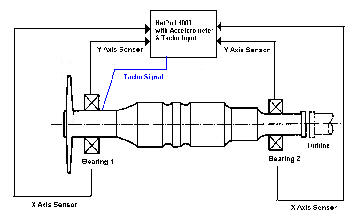
For shaft balancing 2 pairs of vibration sensors are mounted at 90 degrees to each other in the plane of rotation and connected to a synchonised input system. The vibration signals along with a tacho signal, see Fig 9, are processed to determine a shaft orbit plot. An out of balance system will show a distorted orbit pattern and the spectral analysis will show the rocking/vibration components due to the unbalanced load. Depending upon the speed of the the machine under investigation the NetPod 4000 is sufficient for many applications.

Static unbalances being looked at using specialist mechanical techniques are outside the bounds of this document.

A tacho signal generated by a reflective point on the shaft can be used to synchronise the data acquisition operations in order to determine the shaft displacements during run-up and run-down operations.

Both ends of a shaft can be analysed simultaneously and the modes of vibration determined by simply ensuring sufficient channels are installed within the instrument.

To undertake shaft balancing applications with the NetPod 4000 fit accelerometer interfaces into the instrument. Use Part numbers NPAI24-V1H1 NP4210-JIO (Tacho Input)

For high speed applications use the
NDACS 5000 instrument using sensors that provide an output signal proportional to acceleration. For specialist sensors external signal condition will be required


Part Numbers : ND5002, ND5004, ND5008

8

Fig 9