dips1.jpg

System Configuration

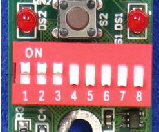
The main system configuration is undertaken using the DIP switch S1 and this switch is used to select the mode of operation of the tilt meter signal conditioning unit.

Figure 7 shows the DIP switch S1
mounted on the tilt meter signal
conditioning unit.

DIP Switch S1 Settings

DIP switches 1 to 7 on S1 is used in normal mode to select the device address.

Up to 128 different node addresses can be used on the same frequency band. The systems address is set in binary, for example:

Table 3 - Channel Selection table

Mode Selection

The TS103 has two operational modes identified as
Normal and Setup and are selected by switch DIP8 on switch S1. See Fig 1.

Normal Mode of operation is when the module transmits level information for each sensor input every 60 seconds then goes into sleep mode between readings.

In
Setup Mode data sensor readings are sampled and transmitted 5 times/Sec and the LED level indicators are illuminated and operational. The operator should zero the instrument in setup mode as the results are updated continuously making this operation simple to carry out.

Table 4 shows the DIP8 switch settings used to select the modes of operation. The exact time between signal transmissions depends upon the address selection and this is done automatically to prevent data collision between different units. The power consumption in this mode is approximately 60 uA.

Level Indictor LED’s

The level indicators operate when the TS103 is in Setup mode only. The indictors only work as specified when the tilt sensor is correctly orientated. Both of the LEDs will be illuminated when the tilt sensor is level. Adjust the tilt sensor towards the single illuminated LED when the sensor is angled away from zero datum position and continue until both level indicator LED’s are illuminated to zero the unit.

Mode Selection DIP Switch

Table 4 - DIP8 Mode Selection Switch

LED status indicator

Button S2

Note. Configuration operations are the same on all the TS103 modules no matter how the component layouts differ.