Features
The GPRS/GSM modem fitted to the instrument is a tri-band device and is suitable for operations in most locations in the world. The VibWire-108-GPRS module automatically makes the network connection and alarm/status messages are presented upon the user display to show the status of the connection.
The cable free operational range of this instrument is limited only by the range of the mobile phone network.
Terminal Port
The terminal port is used to configure the instrument and enables the operator to access the GPRS network via control codes sent to the modem. Status messages returned by the modem can be used to show signal strength, test data transmission etc..
Instrument Configuration For GPRS Network
The following parameters are all that need be assigned in order to send data from the VibWire-108-GPRS across the network and all set using the terminal port.
APN (access point number)
Username
Network Password
IP Address (instrument gateway)
Instrument Tag name
VibWire-108-GPRS
8 x Full 4 Wire Vibrating Wire Sensor Inputs
Unlimited range - GPRS network limitation only
GPRS Network Status messages - Signal strength
Pay-As-You-Go & Contract SIMM Support
SQL Database compatible storage
Data-Upon-Demand
Gas Discharge Lightening Protection all inputs
Local Solid state speaker
Advanced Power Management < 3mA Standby Mode
Full Digital Data Conversion - No sensor setup
Automatic Network Connection
SDI-12/RS485 command set compatible
300 Hz - 9 K Hz sensor range
Automatic Sensor Configuration - Digital Networks
Analogue inputs - Thermistor & 4-20 mA Loops
8 x Full 4 Wire Vibrating Wire Sensor Inputs
Unlimited range -
GPRS Network Status messages -
Pay-
SQL Database compatible storage
Data-
Gas Discharge Lightening Protection all inputs
Local Solid state speaker
Advanced Power Management < 3mA Standby Mode
Full Digital Data Conversion -
Automatic Network Connection
SDI-
300 Hz -
Automatic Sensor Configuration -
Analogue inputs -
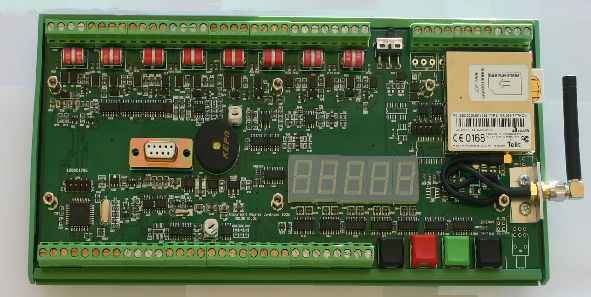
The photographs below show the new Keynes Controls GSM/GPRS ready vibrating wire interface. The instrument below shows everything needed to get 8 x 4 wire vibrating wire sensor data onto the Web/Internet.
Using the GPRS/GSM network true cable free distributed solutions across any range can be created. Instruments can be deployed nationally in many different locations and the results stored to a database. The database can be located anywhere that a suitable network connection can be made.
Indefinite distributed operations are possible due to the instruments advanced power management features. A 4W Solar panel should provide enough power to enable the instrument to send a complete scan of reading every 30 mins.
A wide range of third party antenna are available to fit directly onto this instrument such as small 3 db stubs, directional Yagi when signal strength is low or to achieve longer distances between instrument and data recorder.
Network Transmission Costs
There are no unexpected costs associated with operating the VibWire-108-GPRS/GSM unit across the network since the instrument supports both Pay-As-You-Go and contract SIMMS from most major network suppliers.
Data transmission per scan is as low a 5K so it is easy to obtain the best price plan on Pay-As-You-Go operations and the correct contract SIMM agreement to minimise contract costs. What ever option is taken the User determines how much data is transmitted.
Data Management
Each of the instruments is identified by an assigned name and its information stored into a database. Once the data is being recorded it can accessed and processed to produce reports, plots and trends and even shown on a web page within a 3GL mobile phone.
User Display & Speaker Unit
During installation a User can observe the sensor frequency directly within the on-board display. For sensors deployed a long way from the instrument, embedded into a structure or down holes then a useful feature to determine if the vibrating wire sensors are operating correctly is simply to listen to the returned sensor signal. Should the signal be a tone then the














Page 18